title: 2026 Open Source Selection: These 6 Tools Are Changing Developers' Work Methods date: 2025-03-01 slug: open-source-tools authors: [kevinpeng] categories: - Developer Tools tags: - Open Source Tools - Ghostty - Helix - Jujutsu - OpenTF - LiteFS - Checkov description: 6 most notable open-source development tools for 2026: Ghostty terminal, Helix editor, Jujutsu version control, OpenTF infrastructure, LiteFS distributed database, Checkov cloud security scanning. cover: https://res.makeronsite.com/dashen-tech.com/open-source-tools-cover.webp
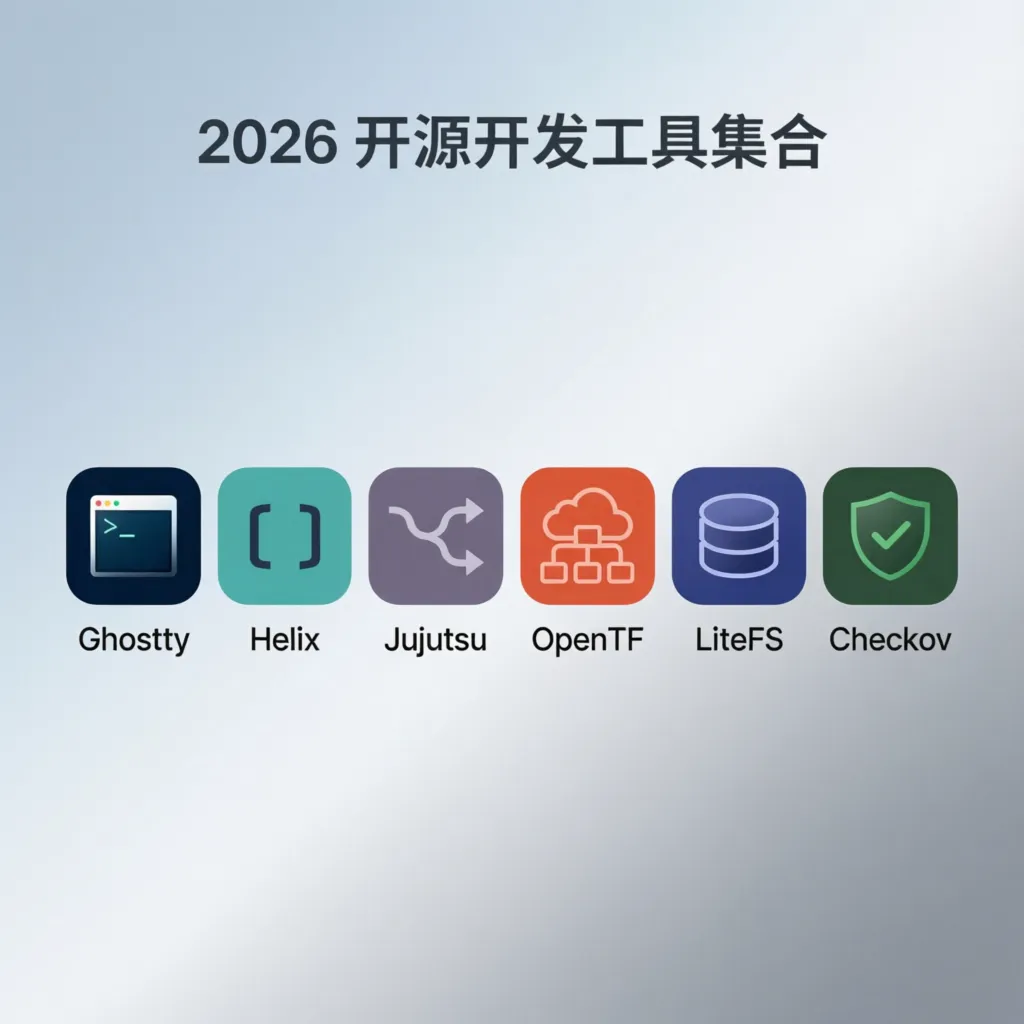

2026 Open Source Selection: These 6 Tools Are Changing Developers' Work Methods
Hello everyone! Two months have passed in 2026, what notable good projects have emerged in the open-source community? Today I'm not talking about AI, but taking stock of several open-source tools that can truly improve daily development efficiency. From terminal editors to databases, from Git workflows to cloud infrastructure, there's always one that suits you.
2026 Open Source Trend Observations
According to the latest GitHub weekly rankings, open-source projects in 2026 show several obvious characteristics:
- TypeScript continues to dominate - TypeScript accounts for over 65% of frontend and full-stack projects
- Rust toolchain rising - More and more system-level tools are being rewritten in Rust
- Developer experience prioritized - Out-of-the-box, zero-configuration has become standard
- Local-first - Privacy and data sovereignty awareness drives local deployment solutions
6 Open Source Projects Worth Paying Attention to in 2026
1. Ghostty 🚀
GitHub Stars: 28k+ | Language: Zig | Category: Terminal Emulator
If you're still using iTerm2 or Alacritty, Ghostty might surprise you. This terminal emulator written in Zig focuses on ultra-fast startup and GPU-accelerated rendering.
Core Highlights: - ⚡ Millisecond-level startup speed - 🎨 Native support for ligature fonts - 🔌 Built-in SSH management - 📱 Cross-platform (macOS/Linux/Windows)
# macOS installation
brew install ghostty

# Linux installation
curl -sSL https://ghostty.org/install.sh | bash
Suitable for: Terminal heavy users, remote developers
Learning difficulty: ⭐
2. Helix ✨
GitHub Stars: 24k+ | Language: Rust | Category: Text Editor
Helix is a strong competitor to Neovim, focusing on out-of-the-box usability. No need to configure hundreds of lines of .vimrc, you can code efficiently right after installation.
Why choose Helix: - 🎯 Built-in LSP support (no plugins needed) - 🔍 Multiple cursors + tree selection - 📦 Built-in code snippets and templates - 🚀 Rust-based, excellent performance
# Quick experience
helix myproject/

# Built-in language support
# Rust, Python, TypeScript, Go, Zig and 50+ languages
Suitable for: People who want to try Vim but fear complex configuration
Learning difficulty: ⭐⭐
3. Jujutsu (jj) 🌿
GitHub Stars: 19k+ | Language: Rust | Category: Version Control
Tired of Git's complex commands? Jujutsu provides a more intuitive way to manage code versions. It works with Git repositories but has more user-friendly operation logic.
Core advantages: - 📝 Automatic workspace snapshot commits - 🔀 More friendly conflict handling - 📚 Gentle learning curve - 🔄 Fully compatible with Git remote repositories
# Initialize (compatible with existing Git repositories)
jj git init

# View changes (clearer than git status)
jj status

# Commit (automatically creates changeset)
jj commit -m "feat: add new feature"
Suitable for: Git beginners, developers tormented by merge conflicts
Learning difficulty: ⭐⭐
4. OpenTF 🔓
GitHub Stars: 15k+ | Language: Go | Category: Infrastructure as Code
OpenTF is the open-source branch of Terraform, rising after HashiCorp changed its license. It maintains true open-source spirit with community-driven development.
Why it's important: - 🛡️ Truly open-source license (MPL 2.0) - ☁️ Supports all major cloud providers - 🔧 100% compatible with Terraform configuration - 👥 Community governance, not controlled by a single company
# Configuration example (fully compatible with Terraform)
terraform {
  required_providers {
    aws = {
      source = "hashicorp/aws"
      version = "~> 5.0"
    }
  }
}

resource "aws_instance" "web" {
  ami           = "ami-0c55b159cbfafe1f0"
  instance_type = "t2.micro"
}
Suitable for: DevOps engineers, cloud architects
Learning difficulty: ⭐⭐⭐
5. LiteFS 💾
GitHub Stars: 12k+ | Language: Go | Category: Distributed File System
LiteFS is an innovative distributed file system designed specifically for SQLite. It makes SQLite work like a real distributed database.
Application scenarios: - 🌐 Web applications deployed across multiple regions - 📊 Need SQLite simplicity + distributed capabilities - 🔄 Automatic failover - 📈 Horizontal read scaling
# Fly.io configuration example
app = "my-sqlite-app"

[deploy]
  regions = ["sin", "nrt", "lax"]

[mounts]
  source = "litefs"
  destination = "/var/lib/litefs"
Suitable for: Independent developers, small teams, edge computing scenarios
Learning difficulty: ⭐⭐⭐
6. Checkov 🛡️
GitHub Stars: 11k+ | Language: Python | Category: Cloud Security Scanning
Checkov can scan Infrastructure as Code (IaC) and container images during the code build phase to prevent cloud security configuration errors in advance.
Scanning scope: - ☁️ Terraform, CloudFormation, Kubernetes - 🐳 Dockerfile best practices - 🔐 Sensitive information leak detection - 📋 Compliance checks (CIS, PCI-DSS, etc.)
# Scan Terraform configuration
checkov -d ./terraform/

# Scan Dockerfile
checkov -f Dockerfile

# Generate report
checkov -d ./infra/ --output junit
Suitable for: DevOps, security engineers, cloud architects
Learning difficulty: ⭐⭐
Practical: Building a Modern Development Environment
Let me share a recommended development environment combination for 2026:
Terminal: Ghostty
    ↓
Editor: Helix (or VS Code + lightweight plugins)
    ↓
Version Control: Jujutsu
    ↓
Infrastructure: OpenTF
    ↓
Database: SQLite + LiteFS (small projects)
    ↓
Security Scanning: Checkov (CI/CD integration)
Advantages of this combination:
- Minimal configuration - Most tools work out of the box
- Excellent performance - Fast Rust/Zig toolchain
- Local-first - Data stays on your own machine
- Cloud-native - Easy deployment to any cloud platform
Open Source Project Selection Suggestions
Faced with so many open-source projects, how to choose? My suggestions are:
| Your needs | Recommended tools |
|---|---|
| Want a faster terminal | Ghostty |
| Want to try Vim but fear complexity | Helix |
| Git gives you headaches | Jujutsu |
| Worry about Terraform license | OpenTF |
| Need distributed SQLite | LiteFS |
| Cloud security compliance | Checkov |
Key principles: - Solve pain points first, don't use for the sake of using - Try in small projects first, then decide whether to migrate - Pay attention to community activity (Issue response speed, PR merge frequency) - Check if the license fits your use case
Written at the End
The 2026 open-source ecosystem is more mature and diverse. Not only AI, but these infrastructure and development tools are also profoundly changing our work methods.
The charm of open source lies in: The problems you encounter have likely already been solved by someone. The key is to maintain curiosity, be willing to try new tools, and also have judgment to choose solutions that truly fit your project.
If you're also using these tools, or have other treasure projects to recommend, feel free to share in the comments!
Related resources: - GitHub Trending - Developer Tools - 2026 Developer Tools Survey Report - Open Source License Quick Guide
Next preview: We will dive deep into how to build a completely autonomous and controllable smart home system using OpenWrt + Home Assistant. Stay tuned!