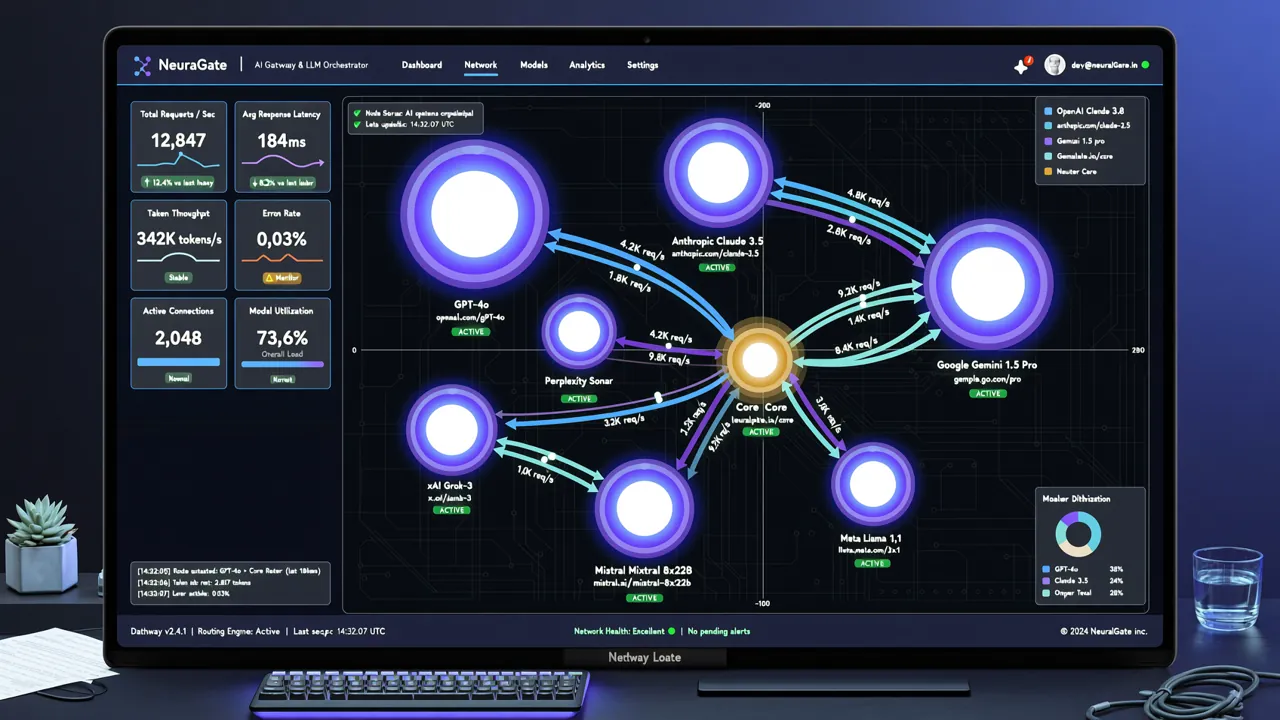
OmniRoute Vollständiger Leitfaden: Kostenloses KI-Gateway, ein Endpunkt für 268+ Large Language Models
TL;DR — OmniRoute ist ein quelloffenes KI-Gateway unter MIT-Lizenz, das 268+ KI-Anbieter (davon 50+ komplett kostenlos) über einen einzigen lokalen Endpunkt bündelt. Mit Auto-Fallback, RTK-Kompression (15–95 % Token-Einsparung), 18 Routing-Strategien und direkter Anbindung an Claude Code, Cursor, Codex und andere Dev-Tools. Auf GitHub 23k+ Sterne, 500+ Mitwirkende.
Warum OmniRoute?
Wenn du gleichzeitig mehrere KI-Dienste nutzt – OpenAI, Claude, Gemini, DeepSeek, Kimi – kennst du bestimmt diese Probleme:
- Jedes Tool braucht seinen eigenen API-Key: Claude Code eine
.env, Cursor eine Einstellung, Codex noch eine andere Konfiguration - Freikontingente sind überall verstreut: Jeder Anbieter hat ein Free Tier, aber das manuell zu verwalten ist nervig
- Ein Dienst fällt aus, der ganze Workflow stockt: Ohne automatisches Fallback musst du manuell wechseln
- Token-Kosten außer Kontrolle: Du weißt nicht, welche Anfrage wie viel kostet
Genau dafür wurde OmniRoute gebaut. Es läuft lokal als Gateway auf deinem Rechner. Alle KI-Tools verbinden sich einfach mit http://localhost:11411/v1 – OmniRoute übernimmt im Hintergrund das Routing zum besten Modell und Anbieter.
Kernfunktionen im Überblick
| Feature | Beschreibung |
|---|---|
| 268+ Anbieter | OpenAI, Anthropic, Google, DeepSeek, Kimi, GLM, MiniMax u.v.m., davon 50+ dauerhaft kostenlos |
| 500+ Modelle | GPT-4o, Claude 4, Gemini 2.5, DeepSeek V4, Qwen 3 – alle wichtigen Modelle abgedeckt |
| 18 Routing-Strategien | Priorität, Gewichtung, Kostenoptimierung, Context-Relay, Fusion-Jury uvm. |
| RTK + Caveman Kompression | Gestaffelte Token-Kompression, spart 15–95 % Token-Kosten |
| Auto-Fallback | Bei quota-Überschreitung oder Ausfall automatisch zum nächsten verfügbaren Modell wechseln |
| 104 MCP-Tools | Integrierter MCP-Server, 3 Transportmethoden |
| A2A-Protokoll | Agent-to-Agent-Kommunikation, 6 Skills |
| Multi-Plattform | Web, Desktop (Electron), Termux, PWA |
| 43 Sprachen | Vollständige Internationalisierung |
Installation
Methode 1: Docker (empfohlen)
# Image ziehen
docker pull ghcr.io/diegosouzapw/omniroute:latest

# Starten (Standard-Port 11411)
docker run -d \
  --name omniroute \
  -p 11411:11411 \
  -v omniroute-data:/app/data \
  ghcr.io/diegosouzapw/omniroute:latest
Methode 2: Direkt mit Node.js
# Node.js 20+ erforderlich
git clone https://github.com/diegosouzapw/OmniRoute.git
cd OmniRoute
npm install
npm start
Methode 3: Desktop-Client
Lade das Installationsprogramm für deine Plattform von GitHub Releases herunter:
- Windows: OmniRoute-Setup.exe
- macOS: OmniRoute-x.x.x.dmg
- Linux: OmniRoute-x.x.x.AppImage
Nach dem Start rufe http://localhost:11411/dashboard auf, um das Admin-Panel zu öffnen.
Schnellstart: Erster Provider in 5 Minuten
Schritt 1: API-Key hinzufügen
Öffne das Dashboard → Providers und klicke auf Add Provider:
Provider: OpenAI
API Key:  sk-xxxxx(dein OpenAI-Key)
Wiederhole den Schritt für weitere Anbieter. Die kostenlosen Provider in OmniRoute:
| Anbieter | Freikontingent | Modelle |
|---|---|---|
| Google Gemini | 60 Anfr./Min. | gemini-2.5-pro, gemini-2.5-flash |
| DeepSeek | Guthaben nach Registrierung | deepseek-chat, deepseek-coder |
| Groq | 30 Anfr./Min. | llama-3.3-70b, gemma-2 |
| Mistral | Guthaben nach Registrierung | mistral-large, codestral |
| Kimi (Moonshot) | Guthaben nach Registrierung | moonshot-v1-auto |
Schritt 2: Verbindung testen
Sende im Playground-Bereich des Dashboards eine Testnachricht:
# Oder per curl testen
curl http://localhost:11411/v1/chat/completions \
  -H "Content-Type: application/json" \
  -d '{
    "model": "auto",
    "messages": [{"role": "user", "content": "Hello!"}]
  }'
Wenn eine normale Antwort zurückkommt, ist die Konfiguration erfolgreich.
Schritt 3: Deine Dev-Tools anbinden
Am Beispiel von Claude Code – setze einfach die Umgebungsvariablen:
export ANTHROPIC_BASE_URL=http://localhost:11411/v1
export ANTHROPIC_API_KEY=any  # OmniRoute benötigt lokal keinen echten Key
Für Cursor-Nutzer: Settings → Models → Base URL auf http://localhost:11411/v1 setzen, API Key beliebig.
Fortgeschrittene Funktionen
18 Routing-Strategien im Detail
OmniRoutes Stärke liegt in der Vielfalt der Routing-Strategien – für jedes Szenario die passende:
Auto-Combo-Modi (Empfehlung für Einsteiger)
Setze das Modell auf die auto-Serie – OmniRoute wählt automatisch basierend auf 12 Faktoren (Health, Quota, Kosten, Latenz, Erfolgsquote …):
| Model ID | Optimierungsziel |
|---|---|
auto |
🎯 Ausgewogen (LKGP – Locks onto last good provider) |
auto/coding |
🧑💻 Code-Qualität zuerst |
auto/fast |
⚡ Niedrigste Latenz zuerst |
auto/cheap |
💰 Günstigste Token-Kosten zuerst |
auto/offline |
🔋 Meiste verbleibende Quota zuerst |
auto/smart |
🔭 Qualität zuerst + 10 % Exploration neuer Modelle |
Beispiel:
curl http://localhost:11411/v1/chat/completions \
  -H "Content-Type: application/json" \
  -d '{
    "model": "auto/coding",
    "messages": [
      {"role": "system", "content": "Du bist ein Python-Programmierassistent"},
      {"role": "user", "content": "Schreib einen Quicksort in Python"}
    ]
  }'
Erweiterte Routing-Strategien
Neben den Auto-Modi unterstützt OmniRoute auch manuell zusammengestellte Strategien:
# OmniRoute Konfigurationsbeispiel
combos:
  - name: "Produktion"
    strategy: "cost-optimized"  # Kostenoptimierung
    targets:
      - provider: "openai"
        model: "gpt-4o-mini"
      - provider: "deepseek"
        model: "deepseek-chat"
      - provider: "groq"
        model: "llama-3.3-70b"

  - name: "Hochwertige Kreation"
    strategy: "fusion"  # Multi-Modell-Fusion + Jury
    targets:
      - provider: "anthropic"
        model: "claude-4-sonnet"
      - provider: "google"
        model: "gemini-2.5-pro"
      - provider: "openai"
        model: "gpt-4o"
Strategie-Erklärungen:
- priority — Der Reihe nach abarbeiten, wenn einer leer ist, weiter zum nächsten
- fill-first — Erst alle Targets bis zur Quota auffüllen, dann wechseln
- weighted — Zufällige Verteilung nach Gewichtung
- cost-optimized — Wählt das günstigste Modell aus dem Echtzeit-Preiskatalog
- context-relay — Kontextübergabe zwischen Targets, ideal für lange Gespräche
- fusion — Sendet gleichzeitig an mehrere Modelle, ein Jury-Modell synthetisiert die beste Antwort
- pipeline — Kette: Jeder Target-Output wird Input für den nächsten
Token-Kompression: RTK + Caveman
OmniRoute hat zwei Kompressions-Engines eingebaut, die API-Kosten deutlich senken:
- RTK (Relevant Token Keeper) — Filtert redundante Tokens, behält den wichtigen Kontext
- Caveman — Strukturierte Kompression mit speziellen Optimierungen für Chinesisch (Klassisch-Modus), Deutsch, Französisch und Japanisch
Kombiniert lassen sich in der Praxis 15–95 % der Token-Kosten einsparen:
# Kompression in der Anfrage aktivieren
curl http://localhost:11411/v1/chat/completions \
  -H "Content-Type: application/json" \
  -d '{
    "model": "auto",
    "compression": {
      "engines": ["rtk", "caveman"],
      "mode": "aggressive"  # balanced | aggressive | conservative
    },
    "messages": [...]
  }'
Kompressionsmodi im Vergleich:
| Modus | Kompressionsrate | Qualitätseinfluss | Einsatzszenario |
|---|---|---|---|
| conservative | 15–30 % | Praktisch keins | Exakte Code-Generierung |
| balanced | 30–60 % | Geringfügig | Alltags-Chat |
| aggressive | 60–95 % | Deutlich spürbar | Schnelles Brainstorming |
Quota-Share (Kontingent-Teilung)
Wenn du mehrere API-Keys desselben Anbieters hast (z. B. zwei OpenAI-Accounts), verteilt Quota-Share das Kontingent fair:
quota_share:
  provider: "openai"
  policy: "soft"  # hard | soft | burst
  keys:
    - key: "sk-xxx1"
      weight: 50
    - key: "sk-xxx2"
      weight: 30
    - key: "sk-xxx3"
      weight: 20
- hard — Strenge Begrenzung, bei Überschreitung wird abgelehnt
- soft — Nach Überschreitung wird die Priorität gesenkt, aber nicht abgelehnt
- burst — Kann ungenutzte Anteile mitverwenden
Praxisbeispiele: Claude Code + OmniRoute
Szenario 1: Kostenloser Coding-Workflow (null Kosten)
Komplett mit Free Providern arbeiten:
# 1. OmniRoute konfigurieren, folgende Free Provider hinzufügen:
#    - Google Gemini (60 Anfr./Min.)
#    - DeepSeek (Registrierungsguthaben)
#    - Groq (30 Anfr./Min.)
#    - Mistral (Registrierungsguthaben)

# 2. auto/cheap Modus setzen
export ANTHROPIC_BASE_URL=http://localhost:11411/v1
export ANTHROPIC_API_KEY=any

# 3. Claude Code ausführen, automatisches Routing zu Free-Modellen
claude 'Hilf mir, die Verzeichnisstruktur dieses Python-Projekts umzubauen'
Szenario 2: Hochverfügbare Coding-Umgebung (Auto-Fallback)
# Fallback-Kette: Claude → GPT-4o → Gemini → DeepSeek
# OmniRoute wechselt automatisch bei jedem Ausfall

export ANTHROPIC_BASE_URL=http://localhost:11411/v1
export ANTHROPIC_API_KEY=any

# Selbst wenn Claude ausfällt, dein Workflow läuft weiter
claude 'Analysiere die Speichersicherheit dieses Rust-Codes'
Szenario 3: Multi-Modell-Vergleich (Fusion-Modus)
curl http://localhost:11411/v1/chat/completions \
  -H "Content-Type: application/json" \
  -d '{
    "model": "auto",
    "strategy": "fusion",
    "messages": [
      {"role": "user", "content": "Erkläre das Ownership-Modell von Rust mit Code-Beispielen"}
    ]
  }'
Im Fusion-Modus werden mehrere Modelle parallel angefragt und ein Jury-Modell (z. B. GPT-4o-mini) synthetisiert die beste Gesamtantwort. Ideal für Szenarien mit höchsten Qualitätsansprüchen an Code.
Vergleich mit anderen KI-Gateways
| Feature | OmniRoute | LiteLLM | OpenRouter | Portkey |
|---|---|---|---|---|
| Anzahl Provider | 268+ | ~100 | ~30 | ~20 |
| Free Provider | 50+ | Sehr wenige | Wenige | Wenige |
| Routing-Strategien | 18 | 3 | 1 | 2 |
| Token-Kompression | RTK + Caveman | Nein | Nein | Nein |
| MCP-Support | 104 Tools | Basis | Nein | Begrenzt |
| Open-Source-Lizenz | MIT | MIT | Kommerziell | Kommerziell |
| Desktop-Client | Ja | Nein | Nein | Nein |
Fazit
OmniRoute ist eines der funktionsreichsten Open-Source-KI-Gateways am Markt. Es löst die drei großen Probleme des Multi-Provider-Managements:
- Einheitlicher Zugang — Ein Endpunkt für alle KI-Tool-Konfigurationen
- Intelligentes Routing — 18 Strategien + Auto-Fallback, immer erreichbar
- Kostenoptimierung — Free-Tier-Bündelung + Token-Kompression, sofort spürbare Einsparungen
Für Entwickler, die täglich mit KI-Coding-Tools arbeiten, ist OmniRoute eine klare Empfehlung für den Tech-Stack. MIT-Lizenz, aktive Community (500+ Mitwirkende), häufige Updates (v3.8.20 → v3.8.49) – da lohnt sich ein Blick.
Projektseite: github.com/diegosouzapw/OmniRoute ⭐ 23k+ Sterne
Nützlich gefunden? Gib OmniRoute einen Stern auf GitHub oder teile deine Konfiguration in den Kommentaren! Wenn dich KI-Gateways, LLM-Routing und ähnliche Themen interessieren, bleib dran bei dashen-tech.com.