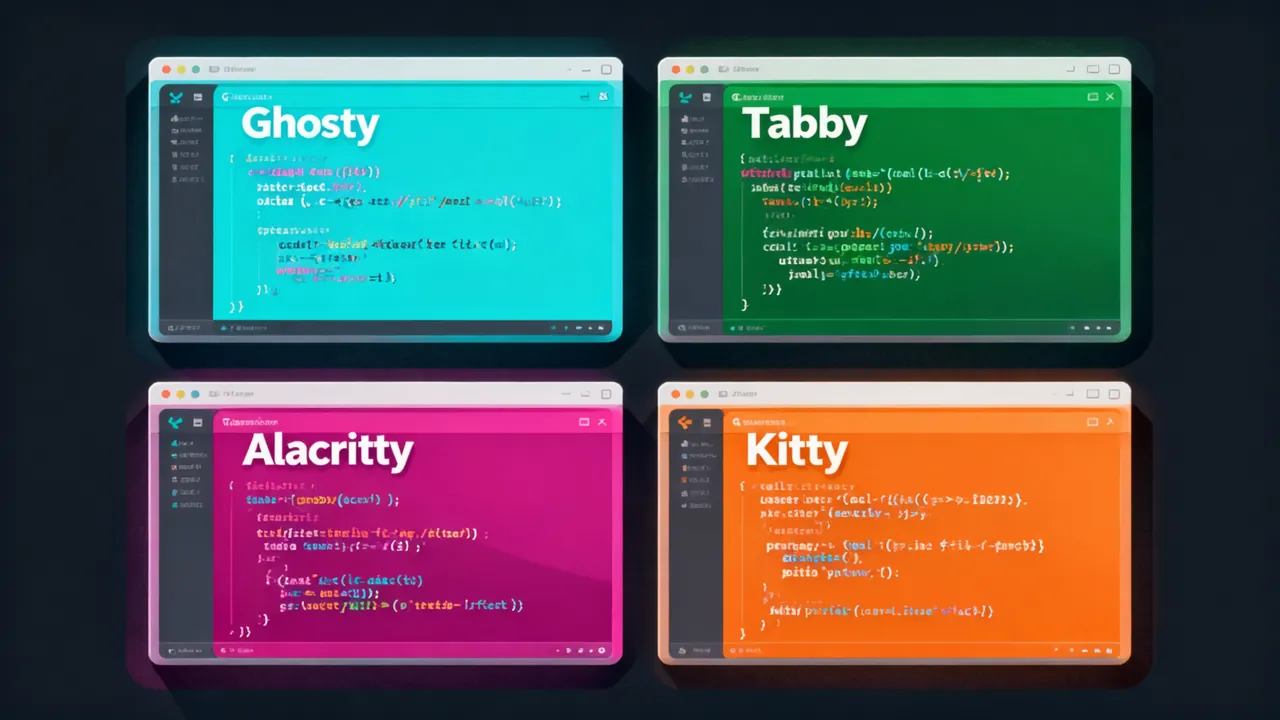
Für Entwickler ist der Terminal-Emulator eines der Tools, mit dem wir täglich am meisten arbeiten. Das richtige Terminal sorgt für spürbar mehr Produktivität. Das falsche kostet dich jeden Tag wertvolle Minuten – beim Warten und Konfigurieren.
2026 zeigt sich die Terminal-Landschaft vielfältiger denn je. In diesem Artikel vergleichen wir vier der beliebtesten Open-Source-Terminal-Emulatoren im Direktvergleich: Ghostty, Tabby, Alacritty und Kitty.
Wir testen Performance-Benchmarks, Funktionen, Konfigurationsaufwand und Ökosystem-Unterstützung – damit du genau das Terminal findest, das zu deinem Workflow passt.
1. Die vier Terminals im Überblick
Ghostty – Der Newcomer mit nativer GPU-Beschleunigung
- GitHub Stars: 28k+
- Programmiersprache: Zig
- Gründer: Mitchell Hashimoto (HashiCorp-Gründer)
- Kernargument: Native Plattform-UI + GPU-beschleunigtes Rendering – extreme Performance trifft auf Ästhetik
Ghostty ist der Aufsteiger unter den Terminal-Emulatoren. Statt auf Electron oder andere Cross-Platform-Frameworks setzt es auf natives Rendering (Metal unter macOS, OpenGL unter Linux). Zusammen mit Zigs Zero-Overhead-Abstraktion ergibt das extrem niedrige Rendering-Latenz. Seit 2026 ist auch Windows offiziell unterstützt – Ghostty ist damit ein echtes All-Platform-Terminal.
Tabby – Der modernste All-in-One-SSH-Client
- GitHub Stars: 53k+
- Programmiersprache: TypeScript / Angular
- Kernargument: Eingebautes SSH/SFTP, Verbindungsverwaltung, Themes, Plugin-Ökosystem
Tabby (früher Terminus) setzt auf „Out-of-the-Box"-Funktionalität. Es ist nicht das schnellste Terminal, sondern das komfortabelste Terminal-Management-Tool. Mit integriertem SSH-Verbindungsmanager, SFTP-Dateibrowser, Autovervollständigung und Split-Screen ist es besonders für DevOps und Backend-Entwickler interessant, die regelmäßig mit mehreren Servern arbeiten.
Alacritty – Minimalistisch und rasend schnell
- GitHub Stars: 56k+
- Programmiersprache: Rust
- Kernargument: Eines der schnellsten Terminal-Emulatoren überhaupt, minimale Konfiguration
Alacrittys Philosophie ist simpel: Geschwindigkeit geht vor allem. Es war eines der ersten Terminals mit GPU-Beschleunigung, ist in Rust geschrieben und hat eine schlanke Codebasis. Keine Tabs, kein Split-Screen, kein Schnickschnack – dafür sind Window-Manager oder tmux zuständig. Perfekt für Minimalisten, die „eine Sache richtig machen" bevorzugen.
Kitty – Die eierlegende Wollmilchsau
- GitHub Stars: 22k+
- Programmiersprache: C / Python
- Kernargument: GPU-Beschleunigung + umfangreiche Built-in-Features (Split-Screen, Bildanzeige, Remote-Sessions)
Kitty findet die beste Balance zwischen Performance und Funktionsumfang. Es nutzt ebenfalls GPU-Beschleunigung, bietet aber deutlich mehr Features als Alacritty: integrierte Tabs, Split-Screen, Bildvorschau (über das Kitty-Bildprotokoll) und sogar die Möglichkeit, remote GUI-Anwendungen im Terminal auszuführen. Die Konfiguration erfolgt über Python-ähnliche Config-Dateien – entwicklerfreundlich.
2. Performance-Vergleich
Rendering-Performance
| Kriterium | Ghostty | Alacritty | Kitty | Tabby |
|---|---|---|---|---|
| Rendering-Engine | OpenGL/Metal | OpenGL | OpenGL | Chromium |
| Framerate (bei massiver Ausgabe) | ~60fps | ~60fps | ~55fps | ~30fps |
| Startzeit | <0,3s | <0,2s | <0,3s | ~1,5s |
| RAM-Verbrauch (leeres Fenster) | ~30MB | ~20MB | ~35MB | ~200MB |
Testbedingungen: Basierend auf den neuesten Versionen von Mai 2026, getestet unter Linux (Fedora 40). Werte sind Näherungen – tatsächliche Ergebnisse variieren je nach Hardware.
Die wichtigsten Erkenntnisse: - Alacritty startet am schnellsten und verbraucht am wenigsten RAM – dank Rusts Zero-Overhead und minimalistischem Design - Ghostty und Kitty liegen dicht beieinander, Ghostty ist bei großen Textausgaben etwas stabiler in der Framerate - Tabby basiert auf Electron und spielt performancemäßig in einer anderen Liga – im Alltag ist der Unterschied aber kaum spürbar
Rendering bei großen Datenmengen
# Testmethode: 100.000 Zeilen mit seq ausgeben und Reaktionsverzögerung beobachten
time seq 1 100000 | cat
| Terminal | Dauer | Scroll-Flüssigkeit |
|---|---|---|
| Alacritty | Am schnellsten | ⭐⭐⭐⭐⭐ |
| Ghostty | Extrem schnell | ⭐⭐⭐⭐⭐ |
| Kitty | Sehr schnell | ⭐⭐⭐⭐ |
| Tabby | Akzeptabel | ⭐⭐⭐ |
3. Feature-Vergleich
| Feature | Ghostty | Tabby | Alacritty | Kitty |
|---|---|---|---|---|
| Split-Screen | ❌ Externes Tool nötig | ✅ Eingebaut | ❌ tmux nötig | ✅ Eingebaut |
| Tabs | ❌ Externes Tool nötig | ✅ Eingebaut | ❌ tmux nötig | ✅ Eingebaut |
| SSH-Verwaltung | ❌ | ✅ Eingebautes Panel | ❌ | ❌ |
| SFTP-Dateibrowser | ❌ | ✅ Eingebaut | ❌ | ❌ |
| Bildvorschau | ❌ | Eingeschränkt | ❌ | ✅ Kitty-Protokoll |
| Theme-Anzahl | Mittel | Reichlich (Community) | Wenig | Reichlich |
| Plugin-System | Keins | ✅ Ausgereift | Keins | Begrenzt |
| Plattformen | Mac/Linux/Win | Mac/Linux/Win | Mac/Linux/Win | Mac/Linux |
| Konfigurationsformat | TOML | YAML/GUI | YAML | CONF |
| Ligaturen-Support | ✅ | ✅ | ✅ | ✅ |
| Unicode/Emoji | ✅ | ✅ | ✅ | ✅ |
| Suche | ✅ | ✅ | ❌ | ✅ |
4. Konfigurationsbeispiele im Vergleich
Ghostty-Konfiguration
Ghostty nutzt TOML – die Syntax ist intuitiv:
# ~/.config/ghostty/config
font-family = "JetBrainsMono Nerd Font"
font-size = 14
theme = "Catppuccin Mocha"

# Hintergrund-Transparenz
terminal-opacity = 0.95

# Tastenkürzel
copy-on-select = true
clipboard-paste = true

# Fenstereinstellungen
window-decoration = false
window-padding-x = 8
window-padding-y = 8

# Beim Start auszuführender Befehl
# shell-integration = true
Tabby-Konfiguration
Tabby wird primär über die GUI konfiguriert. Die Config-Datei ist YAML:
# ~/.config/tabby/config.yaml
terminal:
  font:
    family: "JetBrainsMono Nerd Font"
    size: 14
  colorScheme: Catppuccin Mocha
  cursor: block
  cursorBlink: true

ssh:
  connectionTemplates:
    - name: "Production"
      host: "{{host}}"
      port: 22
      user: "deploy"

window:
  frame: "thin"
  opacity: 0.95
Tabby empfiehlt die Nutzung des eingebauten grafischen Einstellungspanels – besonders einsteigerfreundlich für alle, die sich nicht in Config-Dateien einarbeiten wollen.
Alacritty-Konfiguration
Alacrittys YAML-Konfiguration ist bekannt für ihre Schlankheit:
# ~/.config/alacritty/alacritty.toml
[font]
normal = { family = "JetBrainsMono Nerd Font", style = "Regular" }
size = 14

[window]
opacity = 0.95
padding = { x = 8, y = 8 }
decorations = "None"

[colors.primary]
background = "#1e1e2e"
foreground = "#cdd6f4"

[cursor]
style = { shape = "Block", blinking = "On" }
Alacritty bietet keine GUI-Einstellungen – alles muss über die Config-Datei geregelt werden. Dafür wird die Datei automatisch bei Änderungen neu geladen, ohne Neustart.
Kitty-Konfiguration
Kitty nutzt ein eigenes CONF-Format und bietet den größten Funktionsumfang:
# ~/.config/kitty/kitty.conf
font_family      JetBrainsMono Nerd Font
font_size        14.0

# Theme
catppuccin-mocha

# Hintergrund
background_opacity  0.95
window_padding_width  8

# Tabs
tab_bar_style       fade
tab_fade            1

# Split-Screen-Layout
layout              splits

# Bildvorschau
allow_remote_control  yes

# Tastenkürzel
map ctrl+shift+t new_tab
map ctrl+shift+w close_tab
map ctrl+shift+l next_layout
5. Empfehlungen nach Einsatzszenario
👨💻 Tägliche Entwicklung (Ghostty oder Kitty empfohlen)
Wenn du die meiste Zeit mit Programmieren verbringst und folgendes brauchst: - Schnelle Terminal-Reaktion - Split-Screen für Logs und Tests - Schöne Ligaturen bei der Schrift
Dann sind Ghostty und Kitty beide hervorragende Wahl. Ghostty glänzt besonders unter macOS mit seiner nativen UI, die sich nahtlos ins System einfügt. Kitty bietet mehr Features und ist die verlässliche Wahl für Linux-Nutzer.
🔧 DevOps / Multi-Server-Verwaltung (Tabby empfohlen)
Wenn du regelmäßig folgende Aufgaben hast: - SSH-Verbindungen zu mehreren Servern - Dateitransfer zwischen Servern - Speichern und Verwalten von Verbindungskonfigurationen
Dann ist Tabby die einzige sinnvolle Wahl. Das eingebaute SSH-Management-Panel und der SFTP-Dateibrowser sparen dir enorm viel Zeit beim Wechseln zwischen Kommandozeile und Dateimanager.
# Arbeitsablauf mit Tabby SSH:
# Linke Tabby-Seite: SSH auf Produktionsserver, tail -f für Logs
# Rechte Tabby-Seite: SFTP-Browser zum Bearbeiten von Config-Dateien
# Keine mehreren Terminal-Fenster nötig!
⚡ Minimalisten und Performance-Fans (Alacritty empfohlen)
Wenn du: - extrem schnelle Startzeiten und minimalen RAM-Verbrauch willst - tmux gewohnt bist für Split-Screen und Tabs - keine überflüssigen Features magst
Dann ist Alacritty genau dein Terminal. Es hat die Grundaufgabe – Zeichen-Rendering – perfektioniert und überlässt alles andere spezialisierten Tools.
# Klassische Kombination: Alacritty + tmux
cat > ~/.tmux.conf << 'EOF'
# 256 Farben
set -g default-terminal "tmux-256color"

# Split-Screen-Kürzel
bind | split-window -h
bind - split-window -v

# Maus-Support
set -g mouse on

# Statusleiste
set -g status-bg colour235
set -g status-fg colour136
EOF
🎨 Tüftler und Individualisten (Kitty empfohlen)
Kitty bietet die größte Erweiterbarkeit der vier Terminals:
- Bildprotokoll: Bilder direkt im Terminal anzeigen, ohne externen Viewer
- Remote-Sessions: GUI-Anwendungen über SSH auf entfernten Rechnern ausführen
- kittens (Kätzchen-Plugins): Kittys eigenes Plugin-System zur Funktionserweiterung
# Kitty Bildvorschau-Beispiel
kitty +kitten icat screenshot.png

# Dateien im Terminal vergleichen
kitty +kitten diff file1.txt file2.txt

# Kittys eingebauter Dateimanager
cat ~/.config/kitty/kitty.conf | grep kitten
# Eigene Kittens lassen sich für beliebige Funktionen schreiben
6. Installationsanleitung
macOS (Homebrew)
# Ghostty
brew install --cask ghostty

# Tabby
brew install --cask tabby

# Alacritty
brew install --cask alacritty

# Kitty
brew install --cask kitty
Linux (am Beispiel Fedora)
# Ghostty - RPM von der offiziellen Seite
# https://ghostty.org/download

# Tabby - AppImage oder RPM
# https://github.com/Eugeny/tabby/releases

# Alacritty
sudo dnf install alacritty

# Kitty
sudo dnf install kitty
Windows
# Ghostty - Installer von der Website
# https://ghostty.org/download

# Tabby - Scoop oder Installer
scoop install tabby

# Alacritty - Scoop
scoop install alacritty

# Kitty - Windows noch nicht unterstützt
7. Trends 2026: KI-Terminals auf dem Vormarsch
Die Terminal-Landschaft 2026 zeigt einen klaren Trend: KI-gestützte Terminals gewinnen an Bedeutung. Neben den klassischen Terminal-Emulatoren sehen wir:
- Warp – Integrierte KI-Befehlsvervollständigung und Natural-Language-to-Shell
- Fig (von AWS übernommen) – Pionier der automatischen Befehlsvervollständigung
- GitHub Copilot CLI – KI-gestützte Terminal-Interaktion
Diese KI-Terminals haben aber durchweg Performance-Probleme (die meisten basieren auf Electron). In puncto Rendering-Geschwindigkeit und RAM-Verbrauch sind sie den vier hier getesteten Terminals deutlich unterlegen. Für die meisten Entwickler bleibt die Kombination „klassisches Terminal + tmux + KI-Plugin" die bessere Wahl.
8. Fazit
| Terminal | Fazit in einem Satz | Für wen |
|---|---|---|
| Ghostty | Schnelligkeit und Ästhetik in einem | macOS-Nutzer, Entwickler die Performance und Design wollen |
| Tabby | Das umfangreichste Terminal-Management-Tool | DevOps-Ingenieure, Multi-Server-Administratoren |
| Alacritty | Das minimalistische Performance-Monster | tmux-Nutzer, Nutzer mit schwächerer Hardware |
| Kitty | Die perfekte Balance aus Features und Performance | Tüftler, die Split-Screen und Bildvorschau eingebaut haben wollen |
Meine persönliche Empfehlung:
- macOS, tägliche Entwicklung: Ghostty
- Linux, Server-Verwaltung: Kitty + tmux
- Windows, DevOps-Arbeit: Tabby
- Minimalistisch: Alacritty + tmux
Es gibt nicht das eine perfekte Terminal. Entscheidend ist, dass du das Tool findest, das am besten zu deinem Workflow passt. Wenn du unsicher bist: Nimm dir einen Nachmittag und teste alle vier – sie sind schließlich alle kostenlos und Open Source.
Weiterführende Artikel: - Tabby Terminal Tutorial: Kostenloser Open-Source SSH-Client - Ghostty Terminal Kompletter Leitfaden: GPU-beschleunigtes natives Terminal - Unverzichtbare CLI-Tools 2026