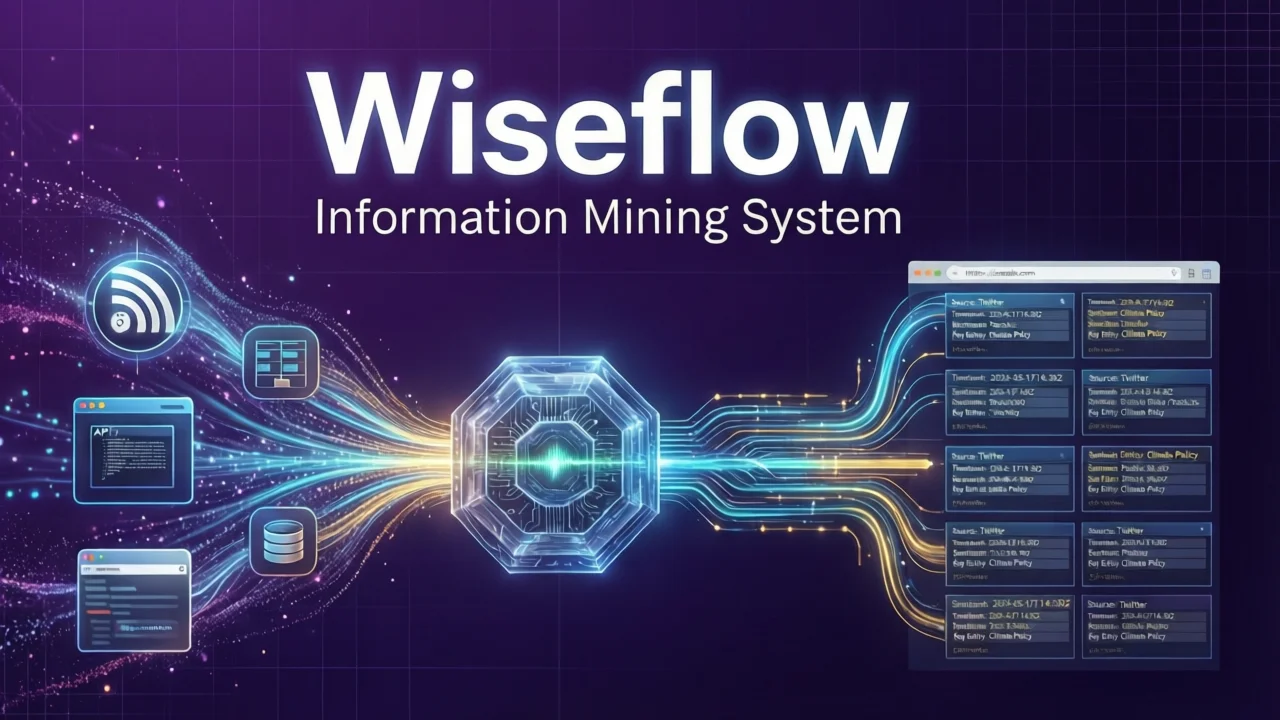
Breaking Through Information Overload
2.5 quintillion bytes of data are generated every day, but truly valuable information may account for less than 1%. The core challenge for developers, entrepreneurs, and marketers isn't "finding information" — it's "extracting actionable intelligence from massive noise."
The Wiseflow project first gained attention as the "AI Chief Intelligence Officer" — an agile open source information mining tool that extracts relevant information from websites, WeChat Official Accounts, social platforms, and other sources based on user-defined focus points, automatically tags and categorizes content, and uploads to databases. Today, this project has evolved into xiaobei — an all-in-one self-media customer acquisition agent built for OPCs and SMEs, powered by the openclaw framework, with 8,400+ stars on GitHub.
This article provides a deep technical analysis of Wiseflow/xiaobei's architecture, core capabilities, deployment walkthrough, and how to integrate it into your Agent project as a dynamic knowledge base.
Full Spectrum of Core Features
Smart Search: Zero-Config Coverage Across 18 Source Types
Wiseflow's most powerful capability is its built-in Smart Search system, covering 18 source categories:
| Source Category | Platforms | Highlights |
|---|---|---|
| Social Media | Xiaohongshu, Douyin, Weibo, Zhihu, Bilibili | Full coverage of Chinese social platforms |
| International | Twitter/X, YouTube, LinkedIn, Reddit | Global information sources in one click |
| Content Platforms | WeChat Official Accounts, Channels | Deep WeChat ecosystem integration |
| Vertical Domains | News, Government, Finance, Academic, Shopping | Precise coverage of specialized fields |
| Developer | GitHub | Real-time tech trend tracking |
Key advantage: No API keys required — completely free. This contrasts sharply with traditional monitoring tools that require API access applications for each platform.
Focus-Point-Driven Extraction Engine
Unlike simple crawlers or RSS aggregators, Wiseflow employs a focus-point-driven extraction model:
- Define focus points: Specify topics, keywords, and entities you care about
- Intelligent extraction: LLM engine extracts information relevant to your focus points from raw content
- Automatic categorization: Semantic understanding enables automatic tagging and classification
- Structured storage: Extracted results are stored in databases for subsequent querying and analysis
The core value is "extract only what you care about," dramatically reducing information noise.
Multi-Agent Collaboration Architecture
Xiaobei adopts a multi-agent architecture with four specialized Crews:
crews/
├── main/              # Main Agent: Content marketing / Startup companion
├── it-engineer/       # IT Engineer: Operations + Troubleshooting
├── content-producer/  # Content Producer: Video/Visual production
└── sales-cs/          # Sales CS: Customer engagement (on-demand)
Each Crew has independent SOUL.md (personality), IDENTITY.md (identity config), MEMORY.md (memory system), and skill sets, collaborating through the openclaw framework.
Full-Pipeline Content Production
From information gathering to content publishing, xiaobei covers the complete workflow:
- Information gathering: Smart Search across 18 source types
- Content creation: WeChat articles, Xiaohongshu graphics, short video scripts
- Visual design: Poster generation, layout, video thumbnails
- Video production: Short video generation, talking-head editing, highlight extraction
- Multi-platform distribution: WeChat Channels, Douyin, Xiaohongshu, Bilibili, Kuaishou, Twitter/X, and more
- Data review: Auto-fetch publishing metrics, content scoring, strategy optimization
Technical Architecture Deep Dive
Information Source Collection Layer
Wiseflow's collection layer is built on a forked camoufox-cli anti-fingerprint browser stack:
Collection Layer Architecture
├── camoufox-cli (forked)    # Anti-fingerprint Firefox browser automation
│   ├── Persistent sessions  # One and only one session per platform
│   ├── Cookie+UA dual export # Complete login state preservation
│   └── Headed/headless toggle # Headed for login, headless for automation
├── login-manager            # Central login state management
│   └── ~/.openclaw/logins/  # Unified platform cookie storage
└── Platform-specific skills # Per-platform collection logic
Design principles: - One persistent session per platform to avoid triggering risk controls - Cookie imports to create sessions are strictly forbidden (device fingerprint mismatch triggers detection) - Lost profiles are rebuilt with fresh login — never import old cookies
LLM Extraction Engine
The information extraction core supports multiple model integrations:
| Model | Purpose | Access Method |
|---|---|---|
| DeepSeek-V4-Flash | Primary model | Alibaba Cloud Bailian Token Plan |
| GLM-5.2 | Alternative primary | Volcano Ark Coding Plan |
| Qwen3.6-Flash | Lightweight tasks | Alibaba Cloud Bailian |
| doubao-seedream-4.0 | Image generation | Volcano Ark |
Recommended setup: Alibaba Cloud Bailian Token Plan (Lite 39 CNY/month, Standard 139 CNY/month) — one key covers primary, vision, and fallback models.
Tag Classification System
Extracted information is automatically categorized through semantic understanding:
- Entity recognition: Identifies people, companies, products, technical terms
- Topic classification: Automatic categorization based on predefined tag systems
- Sentiment analysis: Determines sentiment orientation (positive/negative/neutral)
- Relevance scoring: LLM evaluates information relevance to focus points
Database Storage
Extracted results support multiple storage options:
- SQLite: Lightweight local storage for single-machine deployment
- PostgreSQL: Recommended for production, supports concurrent queries
- Vector databases: Optional integration for semantic retrieval
Data structure example:
CREATE TABLE extracted_info (
    id INTEGER PRIMARY KEY,
    source_type VARCHAR(50),      -- Source type
    source_url TEXT,              -- Original link
    title TEXT,                   -- Title
    content TEXT,                 -- Extracted content
    focus_points JSON,            -- Matched focus points
    tags JSON,                    -- Auto-generated tags
    sentiment VARCHAR(20),        -- Sentiment orientation
    relevance_score FLOAT,        -- Relevance score
    extracted_at TIMESTAMP,       -- Extraction time
    metadata JSON                 -- Extended metadata
);
Local Deployment Walkthrough
Hardware Requirements
Wiseflow/xiaobei has minimal hardware requirements — no GPU needed for fully local deployment:
| Component | Minimum | Recommended |
|---|---|---|
| CPU | 2 cores | 4+ cores |
| RAM | 4GB | 8GB+ |
| Storage | 10GB | 20GB+ |
| OS | Ubuntu 22.04 / macOS / WSL2 | Ubuntu 22.04 LTS |
Note: Windows 10 1803+ requires Git Bash or WSL2. Developer Mode is recommended for symlink support.
One-Click Installation (Recommended)
macOS / Linux (GitHub route):
bash -c "$(curl -fsSL https://raw.githubusercontent.com/TeamWiseFlow/wiseflow/master/scripts/install.sh)"
macOS / Linux (China atomgit mirror):
bash -c "$(curl -fsSL https://raw.atomgit.com/wiseflow/wiseflow/raw/master/scripts/install-atomgit.sh)"
Windows PowerShell (run as Administrator):
# GitHub route
irm https://raw.githubusercontent.com/TeamWiseFlow/wiseflow/master/scripts/install.ps1 | iex

# China atomgit mirror
irm https://raw.atomgit.com/wiseflow/wiseflow/raw/master/scripts/install-atomgit.ps1 | iex
The install script automatically:
1. Downloads pre-built tarball (~140MB) + Firefox anti-fingerprint browser (~557MB)
2. Extracts to ~/xiaobei/ (program directory)
3. Initializes ~/.openclaw/ (runtime data directory)
4. Displays WeChat binding QR code (scan with phone to start using)
API Key Configuration
After installation, the only manual configuration needed is the LLM API key:
# Edit configuration
nano ~/.openclaw/daemon.env

# Add Alibaba Cloud Bailian key
AWK_API_KEY=your_api_key_here

# For video generation, additionally configure
MODELSTUDIO_API_KEY=your_modelstudio_key
Launch and Usage
# Start the main Agent
cd ~/xiaobei
./bin/openclaw start main

# Or chat directly via WeChat (bound during installation)
Directory Structure
~/xiaobei/              # Program directory (replaced on upgrade)
├── openclaw/           # Upstream engine
├── crews/              # Crew templates
├── skills/             # Shared skills
├── scripts/            # Utility scripts
└── bin/openclaw        # Launch wrapper

~/.openclaw/            # Runtime data (user data, preserved on upgrade)
├── openclaw.json       # Configuration
├── daemon.env          # Environment variables (API keys)
├── workspaces/         # Per-Crew workspaces
├── logins/             # Platform login state
└── logs/               # Runtime logs
Real-World Use Cases
Case 1: Tech News Monitoring
Scenario: Track the latest developments in AI Agents, LLMs, and open source tools.
Configuration:
{
  "focus_points": [
    "AI Agent frameworks",
    "New LLM model releases",
    "GitHub trending open source tools",
    "RAG technology advances"
  ],
  "sources": ["GitHub", "Twitter/X", "Zhihu", "WeChat Official Accounts"],
  "schedule": "every 6 hours",
  "output": "daily_digest"
}
Result: Automatic daily tech digest, filtering irrelevant content and keeping only information highly relevant to your focus points.
Case 2: Competitor Intelligence
Scenario: Monitor competitors' product updates, marketing activities, and user feedback.
Configuration:
{
  "focus_points": [
    "Competitor A new features",
    "Competitor B user reviews",
    "Competitor C pricing changes"
  ],
  "sources": ["Twitter/X", "Xiaohongshu", "Weibo", "Product websites"],
  "sentiment_analysis": true,
  "alert_threshold": 0.8
}
Result: Real-time competitor activity capture, automatic alerts for negative sentiment, enabling rapid market response.
Case 3: Building a Dynamic Knowledge Base for Agents
Scenario: Use Wiseflow as the information input module for an Agent project, building a dynamic knowledge base.
Integration approach:
# Pseudocode: Agent calls Wiseflow for latest information
class AgentWithWiseflow:
    def __init__(self):
        self.wiseflow_db = connect_to_wiseflow_db()

    def get_context(self, query: str):
        # Retrieve relevant information from Wiseflow database
        results = self.wiseflow_db.query(
            focus_points=[query],
            limit=10,
            min_relevance=0.7
        )
        return self.format_as_context(results)

    def respond(self, user_input: str):
        # Generate response combining dynamic info from Wiseflow
        context = self.get_context(user_input)
        return self.llm.generate(user_input, context=context)
Advantage: Agents no longer rely on static knowledge bases — they access real-time updated external information.
Integration with Agent Projects
As a Knowledge Base Module
Wiseflow's structured data can directly serve as an Agent's knowledge base:
- Direct database connection: Agent queries Wiseflow's SQLite/PostgreSQL database directly
- API interface: Fetch latest information through Wiseflow's API
- Vector retrieval: Import extracted results into vector databases for semantic search
Combined with RAG
Use Wiseflow as the information source for RAG (Retrieval-Augmented Generation):
User Question → Agent receives
               ↓
Wiseflow retrieves relevant documents
               ↓
Build enhanced prompt
               ↓
LLM generates answer (based on latest information)
Multi-Agent Collaboration
Within the openclaw framework, Wiseflow's multiple Crews can collaborate on complex tasks:
- main Agent: Receives user requests, decomposes tasks
- content-producer: Generates content based on Wiseflow-extracted information
- it-engineer: Maintains system stability, handles technical issues
Comparison with Other Monitoring Tools
| Feature | Wiseflow/xiaobei | Huginn | RSS+LLM | Commercial |
|---|---|---|---|---|
| Source coverage | 18 types (social+news+vertical) | Web-focused | RSS only | Varies |
| API key requirement | None (Smart Search) | Configuration needed | Configuration needed | Paid |
| Information extraction | LLM focus-point driven | Rule engine | Simple summary | Varies |
| Auto-categorization | Semantic tags | Manual rules | None | Partial |
| Content production | Full pipeline (text+image+video) | None | None | Partial |
| Multi-platform publishing | 10+ platforms | None | None | Varies |
| Local deployment | Supported, low requirements | Supported | Supported | Not supported |
| Open source | Fully open source | Open source | Open source | Proprietary |
| Agent integration | Native support | Custom dev needed | Custom dev needed | Not supported |
Wiseflow's core advantages: 1. Zero-config source access: Smart Search requires no per-platform API applications 2. Focus-point driven: Not simple crawling — extraction based on actual needs 3. Full pipeline closure: One-stop from information collection to content publishing 4. Native Agent integration: Directly usable as an Agent's knowledge base module
Limitations and Considerations
Current Limitations
- Anti-fingerprint browser dependency: camoufox-cli requires downloading ~557MB Firefox browser, making first installation slower
- Platform risk control: Frequent collection may trigger platform risk controls — frequency must be managed
- Login state maintenance: Some platforms require periodic re-login; expired cookies need manual handling
- Windows support: Requires Git Bash or WSL2; native support is limited
Best Practices
- Control collection frequency: Avoid triggering platform risk controls; recommend once every 6 hours
- Set precise focus points: More specific focus points yield better extraction and less noise
- Maintain login state regularly: Check platform cookie expiration and re-login promptly
- Use domestic mirrors: Chinese users should use atomgit routes to avoid GitHub access issues
- Backup runtime data: Regularly backup
~/.openclaw/directory to prevent data loss
Compliance Reminders
- Comply with each platform's terms of service and robots.txt rules
- Do not use for collecting personal privacy information or sensitive data
- Commercial use must consider copyright implications
- High-frequency collection may result in IP bans — consider using proxies
Final Assessment
Wiseflow/xiaobei represents a successful evolution from an information mining tool to a comprehensive marketing Agent. Its core value lies in:
Strengths: - ✅ Zero-config coverage of 18 source types, completely free Smart Search - ✅ LLM focus-point-driven extraction, not a simple crawler - ✅ Full-pipeline content production: gathering → creation → publishing → review - ✅ Multi-agent collaboration architecture, highly extensible - ✅ Local deployment with low hardware requirements, full data sovereignty - ✅ Fully open source with active community (8,400+ stars)
Weaknesses: - ⚠️ Large anti-fingerprint browser size, slow first installation - ⚠️ Platform risk controls require self-managed frequency - ⚠️ Windows support requires additional configuration
Ideal use cases: - Content creators: One-stop content production + multi-platform distribution - Entrepreneurs / Product managers: Competitor monitoring, market insights - Developers: Tech news tracking, open source project monitoring - Agent developers: Dynamic knowledge base for AI agents
Rating: ⭐⭐⭐⭐⭐ (5/5)
For individuals or small teams needing to build an information monitoring and content production system from scratch, Wiseflow/xiaobei is currently one of the most complete solutions available in the open source community. It solves not just "where does information come from" but "how to make information valuable."
Frequently Asked Questions (FAQ)
1. What's the relationship between Wiseflow and xiaobei?
Wiseflow is the original project name (formerly called "AI Chief Intelligence Officer"), while xiaobei is the current brand name. It's the same codebase — functionality has expanded from pure information mining to a complete self-media customer acquisition agent. The GitHub repository is still named TeamWiseFlow/wiseflow.
2. Is Smart Search really completely free?
Yes, Smart Search requires no API key configuration and works out of the box. However, the LLM extraction feature requires a model API key (e.g., Alibaba Cloud Bailian Token Plan, starting at 39 CNY/month for Lite).
3. Can I use only the information mining features without content production?
Absolutely. Wiseflow's core information mining is independent — you can configure only Smart Search and database storage without using content production and publishing features.
4. How to avoid platform risk controls?
- Control collection frequency (recommend once every 6 hours)
- Use persistent sessions to avoid frequent logins
- Don't high-frequency scrape a single platform
- Follow each platform's robots.txt and terms of service
5. Can it be integrated into existing Agent projects?
Yes. Wiseflow stores extracted data in SQLite/PostgreSQL — your Agent can query the database directly or fetch latest information via API. Extracted results can also be imported into vector databases for semantic retrieval.